




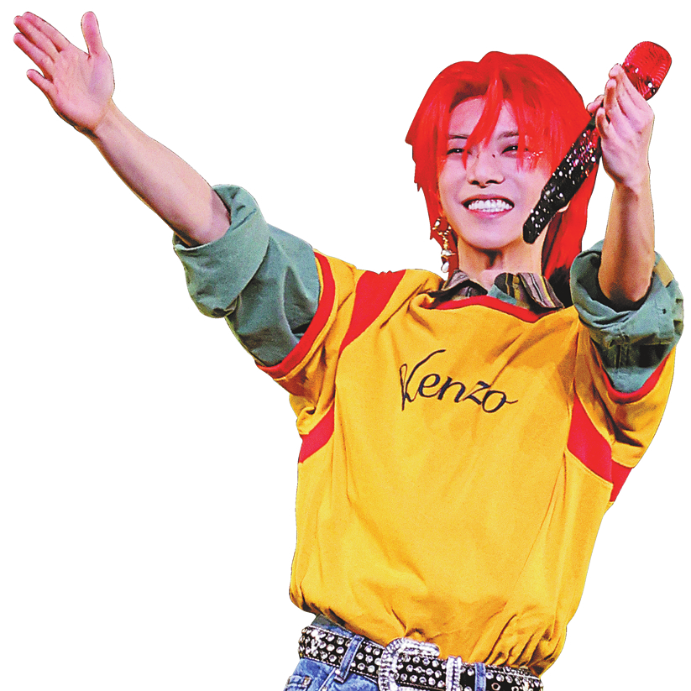

Chinese singer-songwriter Hua Chenyu is reimagining what a concert can be — transforming a live music performance into an immersive experience where music, nature and fans come together.
During the latest "Mars Concert" Park 2.0 residency at Tangshan Music Valley in Nanjing, Jiangsu province, which ran from September to mid-November, the experience extended far beyond the stage.
Fans could spend an entire day exploring art installations, camping, dining, and engaging in interactive activities, making the concert as much about shared experiences as it is about music.
For Hua, however, some of the most memorable moments happened during the performances.
"For the first time, I put on a down jacket on stage while singing, because the fans were yelling at me to add more clothes," Hua recalls with a gentle smile during an exclusive interview with China Daily.
He adds that, on another occasion, when he was about to play his usual piano accompaniment, the audience insisted that he hold an umbrella against the rain. Unable to play, he stood on stage, quietly listening to a chorus of voices singing back to him.
By moving performances out of indoor stadiums, the "Mars Concert" Park 2.0 outdoor format represents an innovative model for China's live entertainment industry. It is also a major driver of local tourism, a cultural experiment and an opportunity for the artist to explore new possibilities in the relationship between music and the audience.
Tangshan Music Valley is located in the Tangshan area of Nanjing's Jiangning district, known for its natural hot springs, rolling hills and pink muhly grass fields.
"When we first conceptualized this, we needed a place that wasn't just a stage, but a truly immersive destination," says Hua.
"We wanted a space that integrated eating, drinking, playing, and camping, while also offering convenient transport and harmonizing with the natural scenery. Tangshan Music Valley was the perfect fit."

Beyond the stadium
Unlike the conventional stadium format of a three-hour performance followed by an immediate departure, the music valley introduces "one ticket, full-day access".
The sprawling venue is divided into three main zones: the performance area, the "Mars Utopia" art installation area, and the Mars campsite. This campsite is also open to the public without concert tickets, allowing local residents to share in the atmosphere.
This format's economic impact has been considerable. The Nanjing residency ran for 52 days and featured 13 shows, drawing over 1.17 million tourist visits to the Tangshan area and generating approximately 2.4 billion yuan ($359 million) in total regional consumption. During the Mid-Autumn Festival and National Day holidays alone, the area recorded nearly 540,000 visits.
Beyond its economic impact, the park's physical centerpiece is equally ambitious. Constructed using approximately 2,000 metric tons of steel, the stage features structures reaching 30 meters tall.
Its core is an "eight-plus-one" configuration, comprising eight massive, movable triangular-prism structures and a separate entrance installation. Each of the nine structures has three display faces, creating what the organizers describe as a "27-sided" stage.
"I first thought of a cyberpunk, futuristic world," Hua says.
"But because we are outdoors, I felt we could merge with nature. We created a water-curtain effect on the big screen that displays a naked-eye 3D waterfall. Visually, it is a fusion of the future and nature."

This combination of contemporary stage design and traditional Chinese aesthetics also runs through the concert's musical narrative, particularly its much-discussed "Black and White" twin setlists.
Rather than incorporating traditional cultural symbols, Hua draws on the ancient Chinese philosophy of yin and yang, to explain the two contrasting dimensions of his music.
"Over the past decade of my career, I've written a lot of music, and it generally falls into two broad dimensions," Hua explains.
"Some songs are sunny, healing and innocent, while others are rock-oriented, rebellious and meant to help people release their deepest inner struggles.
"It feels very much like Chinese taiji — the yin and yang. I write confusion and pain into the sunny songs, and I embed hope within the pain.
"By dividing them into two setlists, the audience can clearly grasp these distinct styles. When they are woven back together, it creates an entirely new experience."
This combination of Chinese philosophical ideas and contemporary musical expression has also attracted listeners from beyond China. Fans from as far away as Brazil and Norway traveled to China specifically for the Nanjing residency.
"I don't really distinguish which country a specific musical scale belongs to anymore," says Hua.

"I can take Chinese melodies and blend them with global harmonic structures. Music has no borders. If I make the music well, people will naturally come to listen."
While the scale of his performances and his audience continue to expand, Hua's creative philosophy has increasingly turned inward. Three years ago, during his 10th-anniversary concerts at Beijing's National Stadium, also known as the Bird's Nest, he emphasized music's ability to offer comfort to people facing emotional difficulties.
Today, this inward-looking philosophy finds expression in his new song, Bu Feng Pei (Not Playing Along), which he debuted during the Nanjing residency. The song explores rejecting "internal friction" and protecting personal boundaries.
"I've been thinking about internal friction for a long time, and I wanted to translate my understanding of it into music," Hua says. One of the song's central lyrical hooks revolves around a modified version of the French word salut.
"In French, salut can mean both 'hello' and 'goodbye' in informal conversation," he explains.
"I removed the 't' at the end so it becomes an open-ended word for people to interpret.
"The concept is: Hello, anyone is welcome into my world. But if I find that you bring no meaning to my life and only cause me internal friction, then goodbye. We have to learn how to say 'no'.

"When you hear it live, and everyone sings that slogan-like lyric together, it is incredibly freeing."
He points out that this invisible pressure extends beyond the workplace and often stems from personal relationships — family, friends or partners.
"But philosophically speaking, all these burdens can actually be let go of. It simply depends on whether you are willing to take that step and make the choice," Hua says.
The shift from offering emotional comfort to encouraging listeners to protect their personal boundaries has struck a chord with many young fans who are navigating increasingly complex interpersonal demands.
Through his latest work, Hua encourages listeners not just to seek healing, but to establish their own peace. This newfound clarity coincides with a major career milestone. Having marked his 100th solo concert on Nov 15, Hua reflected on his journey with a quiet sense of contentment.

A family of fans
For an artist who debuted 13 years ago on a televised talent show, his evolution into a major concert draw and an artist exploring new possibilities at the intersection of music and tourism has far exceeded his initial expectations.
"When I debuted, I never thought about 100 shows. I thought maybe I'd do one a year, and after 10 years, I'd have 10 shows," he says with a laugh.
"Reaching 100 is unexpected. But looking back at my concerts, I have absolutely no regrets. I feel very happy."
The bond he shares with his fans, affectionately known as "Martians", has evolved beyond traditional fandom dynamics into a relationship that feels like family.
"It can't be strictly measured by kinship, romance or friendship, yet it seems to contain all three," he reflects. "Because it is so solid, I wanted to build a true 'home' for us."
This ambition has taken shape in the Nanjing residency, where fans have found a space to connect beyond the concert itself. One of them is Tian Tian, a Fudan University student who was invited to attend the show for free through the "Mars Reward Plan", an initiative organized by Hua's team to recognize fans who have achieved academic milestones.
She described the experience as more than simply attending a concert.
"By creating such a large-scale park, he has given us a space where we can experience the immediacy of being there, return to the realities of everyday life, and reconnect with one another more tangibly," Tian says.
Looking ahead to 2027, Hua is preparing to release a new studio album. After more than a decade of exploring different musical styles and performance formats, he says he is approaching his next creative phase with a clearer sense of his musical direction.
For now, he is focusing on returning to the studio, where the next chapter of his musical journey will take shape.

If you have any problems with this article, please contact us at app@chinadaily.com.cn and we'll immediately get back to you.

