




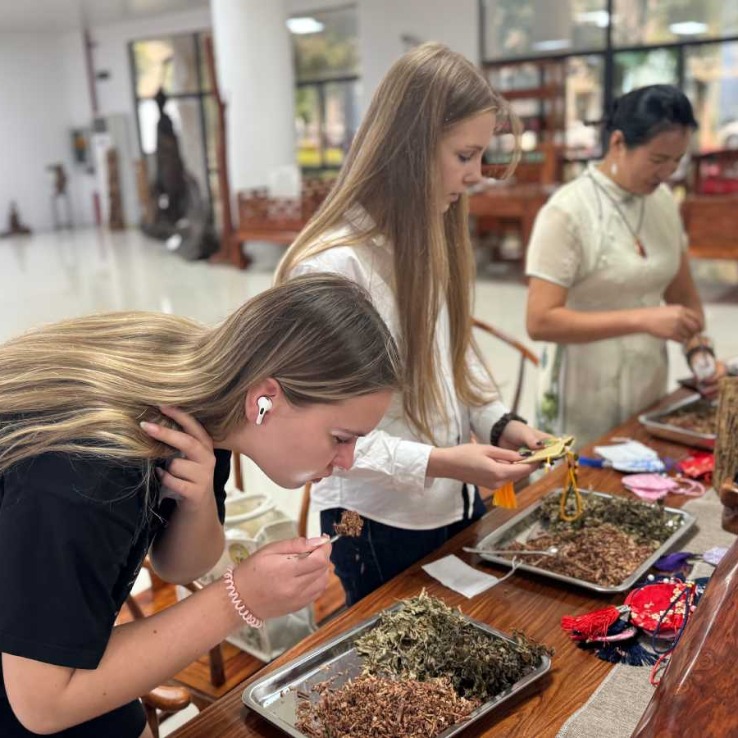

A 36-member delegation of students, teachers and parents from Secondary School No 606 in St. Petersburg's Pushkinsky District visited Hainan University on Friday for the inaugural Russian Youth and Hainan University Faculty-Student Cultural Exchange, an event that organizers described as a cornerstone of people-to-people ties between Russia and China.
The exchange, organized by the Academy of Chinese Wisdom and Cultural Mirrors at Hainan University under the academic leadership of its director, Zhao Yanchun, a top professor at the university, was part of a 13-day study tour of Hainan from Oct 5 to 17. Held under the framework of the 2026–2027 China-Russia Year of Education, it placed youth dialogue at the center of bilateral relations.

The exchange, themed "mutual learning among civilizations", was designed to give young Russians direct exposure to Chinese wisdom, promote cross-cultural understanding, and help lay a foundation for long-term friendship between the two sides.
At the opening ceremony, faculty and student representatives from both countries planted an agarwood sapling in front of the academy building, a symbolic gesture of shared growth. The program also featured a demonstration of Chinese incense culture.
Russian students then rotated through hands-on workshops, making tea bags, sachets and face masks, as well as cloisonne and rosewood sachet crafts. In the afternoon, the focus shifted to recitations of classical poetry and singing of popular Chinese songs, through which students experienced the rhythms of spoken Chinese.

Zhang Falian, academic vice-president of Hainan University, said in his remarks that the event used culture as a bridge and youth as a medium, calling it a vivid example of mutual learning between the two civilizations. He expressed hope that young Russians would carry forward China-Russia friendship — a message that underscored the event's aim of turning today's exchange into tomorrow's enduring ties.
Zhao Yanchun said traditional Chinese culture is a shared treasure of humanity and that mutual learning among civilizations is a key path toward building a community with a shared future for humanity. He added that the academy will continue to leverage its academic and platform strengths to develop more international cultural exchange programs, ensuring that young people in both countries have more opportunities to connect.
"Through intangible cultural heritage activities and hands-on workshops — cloisonne, traditional Chinese medicine experiences and more — everyone will fall more and more in love with China's fine traditional culture," he added.

For the visiting students, the exchange left them with a strong impression and a clear appetite for deeper ties.
Ivan Kirillov, 16, said he was drawn to the Li ethnic clothing on display, and to the parallels he saw with his own culture.
"I like the Li ethnic clothing design, and it just looks familiar to Russian national costumes, and I think they are very beautiful," he said.
Mikhail Khlebnikov, 16, said he enjoyed his time at the university.
"I really like China and its people and culture. I want to visit this country again," he said.
"At Hainan University, the cultural activities are really cool. We made different souvenirs, and we played different traditional instruments."

Kate Makar, 16, said the exchange held significance for young people in both countries.
"I really love Chinese culture because it has a long history and it's very unique," she said.
"It's really important for Russian and Chinese teenagers to communicate with each other, because we have a history together and we also have a lot of things together, and I think our countries love each other and people love each other," Makar said.


If you have any problems with this article, please contact us at app@chinadaily.com.cn and we'll immediately get back to you.

