





The extravagant lifestyle of the Jia family in the great 18th-century novel Dream of the Red Chamber comes vividly to life in its descriptions of feasting, dressing, travel, and domestic spaces.
One chapter recounts the lavish gifts presented for the 80th birthday of Granny Jia, the family's emotional anchor and center of power. Among them is a 12-panel folding screen of exceptional craftsmanship, decorated with pictorial designs created using the costly kesi (cut-silk) tapestry technique. Granny Jia orders that the screen be carefully stored and not moved.
When reading the novel, one can only imagine what such a screen might have looked like. Granny Jia calls it "of the finest quality".
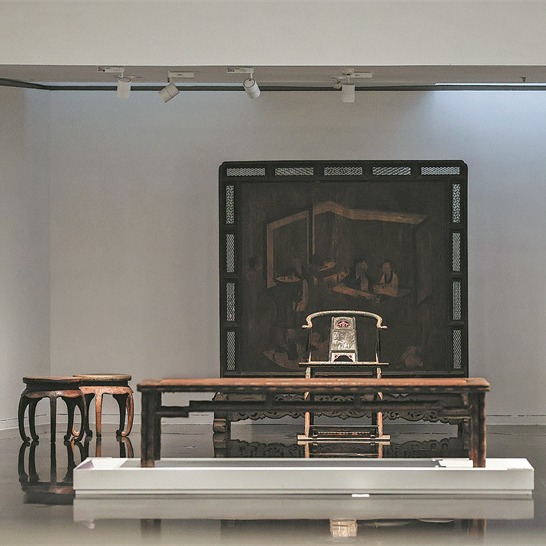
Today, visitors to the Tsinghua University Art Museum in Beijing can see a screen of a similar size and comparable magnificence.

The 12-panel wooden screen, dating to the 18th or 19th century, stretches across much of a wall in the exhibition hall. It is difficult to miss, standing 3.75 meters tall. Its lower section is carved with scenes from the story of the Eight Immortals (legendary Taoist figures), along with auspicious motifs including chilong (hornless dragon-like creatures from Chinese mythology), bats and flower-filled vases.
Xu Xiaochuan, a scholar of classical Chinese furniture at the Academy of Arts and Design, Tsinghua University, says the screen was likely presented as a birthday gift or intended for use during grand celebrations, and kept in storage at other times.
He explains that social hierarchies were strictly observed in ancient China, and such a large and elaborate object would have been associated with a family of considerable status and influence.

The screen is among the highlights of Knowing Realm, Exploring Origins: Ming and Qing Furniture Culture and Art Exhibition, running until Nov 15 at the Tsinghua University Art Museum. The exhibition brings together more than 100 outstanding examples of furniture from the Ming (1368-1644) and Qing (1644-1911) dynasties.
Their elegant silhouettes and refined craftsmanship continue to command admiration today. Yet, the exhibition looks beyond their sophisticated structures, diverse materials and technical mastery to explore the cultural values embedded in everyday furnishings.
Lu Xiaobo, director of the Tsinghua University Art Museum, says a museum's role is not only to preserve valuable objects handed down through generations, but also to revive traditions and bring them into contemporary life through research, exhibitions and interpretation.

The exhibition offers an opportunity to "look back at classical Chinese furniture, not simply to rekindle our interest in the past, but more importantly, to deepen our understanding of the wisdom embodied in these well-proportioned structures — the rules of boundaries, order, nature, and living — so that we may draw insights for the future", Lu says.
The development of Chinese furniture can be traced to the Han Dynasty (206 BC-AD 220). It reached maturity during the Song Dynasty (960-1279) before flourishing during the Ming and Qing dynasties.
"The commodity economy and maritime trade prospered in the Ming and Qing periods, prompting interactions among artisans," says Sun Yiwei, one of the exhibition's co-curators.
"Prevalent cultural exchanges, both within China and with the outside world, jointly provided fertile ground for furniture art to reach a pinnacle."

The exhibition also explores how furniture embodied an elegant way of living, social etiquette and intellectual self-cultivation. These values were expressed through everyday acts, such as working at a table, sitting on a stool, or opening a cabinet.
Xu compares appreciating the furniture to walking through a classical Chinese garden. "As you move, each glance catches a fresh vista, and the winding path leads to quiet seclusion," he says.
Some pieces reflect the dignity, authority and adherence to established standards valued by the ruling class and high society.
The "official's hat" armchair is among the best-known forms of classical Chinese furniture. Its name comes from the curved crest rail, which resembles the winged hat worn by Ming officials.

The exhibition presents a set of four such armchairs, whose clean, sharply defined outlines create a solemn presence. Each chair has a curved splat with a round aperture above a square cutout, echoing the ancient Chinese concept of tian yuan di fang — the idea of a round heaven and square earth.
Another highlight is a floor screen dating to the 15th or 16th century, featuring the distinctive design of a "screen within a screen". It depicts a gathering of scholars examining cultural objects in front of a folding screen bearing a painting.
Xu says the scene reflects the aspirations of ancient intellectuals: those admiring the screen might imagine that, one day, they themselves could become the figures portrayed within it.
If you have any problems with this article, please contact us at app@chinadaily.com.cn and we'll immediately get back to you.

