




The Migdal effect, a decades-old puzzle in particle physics that was experimentally confirmed for the first time by a Chinese team, featured in this year's physics exam of the college entrance examination in Beijing. Its lead researchers were also among the more than 16,000 students who completed their studies this year at the University of Chinese Academy of Sciences.
UCAS President Zhou Qi, an academician of the Chinese Academy of Sciences, urged graduates to prioritize national needs, become leaders of change and uphold the enduring legacy passed down through generations of scientists.
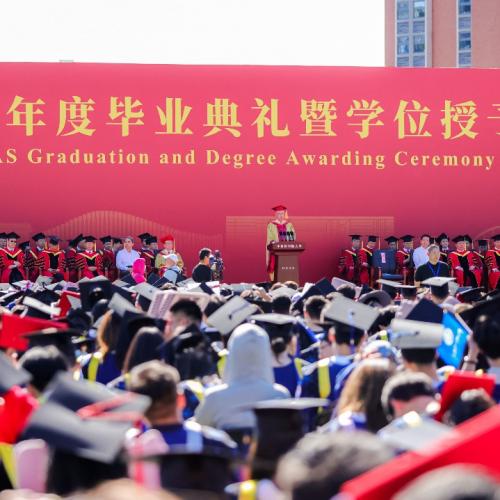
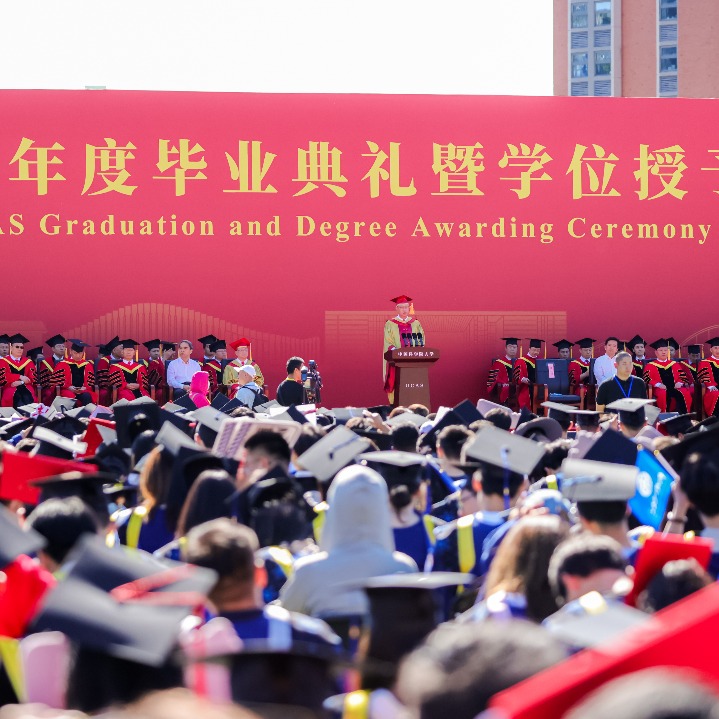
"You should take great pride, for the incoming Class of 2026 in Beijing will be the very first to crack the 'scientific code' you helped set," Zhou told lead researchers Su Chenguang and Yi Difan at the university's graduation ceremony at the Yanqi Lake Campus on Sunday. More than 8,000 graduate representatives and over 20,000 family members attended the event.
The Migdal effect, first proposed by Soviet physicist Arkady Migdal, is regarded as a key mechanism for detecting dark matter — the invisible substance believed to make up the vast majority of the universe's mass.
Recalling the team's research journey, Yi said they endured countless failed experiments and data-analysis bottlenecks after he joined the lab as a sophomore.
"True scientific breakthroughs never come from a sudden spark of genius, but from the quiet eruption of quantitative change into qualitative leaps over countless ordinary days," he said.

Both Yi and Su plan to continue research in high-energy physics after graduation.
"It still has some distance from practical applications," Su said. "But as research deepens, perhaps in one or two centuries, it will become cutting-edge technology that people use in daily life."
Undergraduate representative Gao Aiqi echoed that spirit of perseverance.
In the electron microscopy laboratory, she faced repeated setbacks, studying unfamiliar concepts and coping with disappointing results.
"There is no shortcut to breaking through bottlenecks — only diligent study and calm analysis," said Gao, whose graduation thesis was rated the best in her major.
She said UCAS allows students to grow at their own pace and encourages steady accumulation of knowledge.
"The pioneers here understand better than anyone that the path to scientific pinnacles is inevitably strewn with thorns," she said.
The ceremony also marked a milestone for the university's School of Advanced Interdisciplinary Sciences, established in February 2025.
Its first five graduates received customized degree certificates on Sunday annotated with the names of participating institutes, schools and innovative enterprises, along with mentor signatures, serving as official recognition of their interdisciplinary training and professional competence.
"Interdisciplinary study is not a patchwork of fields, but a methodology for solving problems," said Liu Fangrui, a doctoral graduate whose research integrates computer science, artificial intelligence and fluid mechanics.
He said he and the other four graduates will bring their interdisciplinary expertise to universities, aerospace research institutes and other institutions after graduation, contributing to major national programs.
Doctoral graduate Zhong Tianhua said the university's integration of research and education gave him the opportunity to participate in the national lunar exploration program, where he analyzed lunar surface data from the Chang'e 6 mission.
"Our every breakthrough relies on the support of major national programs and the world-class research platform UCAS provides," Zhong said. "Only when personal academic interests resonate with national needs can one unleash one's greatest potential."
"Scientific innovation is never the struggle of one individual or one generation; it is a legacy passed down through time," Zhou said.
"I hope you will uphold integrity while innovating, forging ahead with steady and sustained progress," he added.
If you have any problems with this article, please contact us at app@chinadaily.com.cn and we'll immediately get back to you.

