




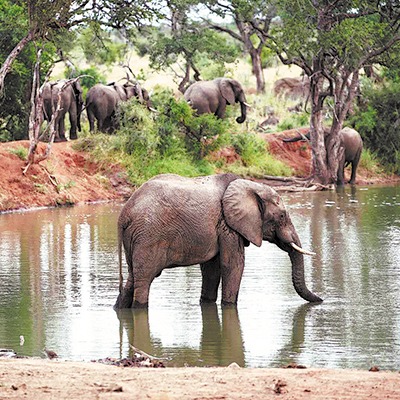

As global travelers seek sustainable and meaningful journeys, Limpopo — South Africa's northernmost province — is emerging as a destination that blends biodiversity conservation with authentic cultural experiences.
Here, where ancient trees punctuate vast horizons and wildlife roams freely across untamed landscapes, ecotourism is more than an attraction; it is a way of life rooted in conservation, culture, and community.
Visitors are drawn into immersive experiences that go beyond traditional game viewing, from exploring pristine wilderness to engaging with local traditions preserved for generations.
Moses Ngobeni, chief executive officer of Limpopo Tourism Agency, said the province's rich natural heritage and commitment to conservation position it as a leading ecotourism destination.
He highlighted biodiversity as one of Limpopo's greatest strengths. "The province is home to world-renowned conservation areas such as Kruger National Park and Mapungubwe National Park, where visitors can encounter diverse wildlife, including the iconic Big Five (lions, elephants, buffalo, rhinoceroses and leopards), within well-protected ecosystems," Ngobeni said.
Kruger National Park remains a major international safari destination, while Mapungubwe is celebrated for its archaeological heritage and cultural landscape.
The province also hosts key conservation areas such as Marakele National Park and the Waterberg Biosphere Reserve, demonstrating its commitment to sustainable environmental management.
Marakele — meaning "place of sanctuary" in Tswana — lies in a transitional ecological zone, allowing for remarkable biodiversity. Visitors can enjoy scenic mountains, rare trees and soaring Cape vultures alongside abundant wildlife.
The Waterberg Biosphere Reserve, a UNESCO-designated site spanning 15,000 square kilometers, is known for its mountain ranges, savanna ecosystems and rich cultural heritage.
As South Africa's first savanna biosphere, it balances conservation with tourism, offering rugged landscapes ideal for hiking and safaris.
Beyond its natural attractions, Limpopo's ecotourism is enriched by its deep cultural and historical heritage.
The Mapungubwe Cultural Landscape, located at the confluence of the Limpopo and Shashe rivers, reflects the legacy of one of Africa's earliest kingdoms. The site features the remains of a sophisticated trading society, including the famous Golden Rhino artifact.
Once the largest kingdom in the subcontinent before its decline in the 14th century, Mapungubwe offers rare insights into early social and political systems through its preserved palace sites and settlements.
Limpopo's strategic location near Zimbabwe, Mozambique, and Botswana enhances its appeal as part of regional tourism circuits.
"Cross-border collaboration promotes cultural exchanges, multicountry itineraries and wildlife tourism, helping attract international visitors and strengthening regional economic ties," Ngobeni said.
The province's warm climate and year-round accessibility support a wide range of ecotourism activities, including guided nature walks, bird-watching, hiking and cultural experiences.

Bringing the wild to life
For visitors, Limpopo offers not just scenic beauty but memorable, sometimes dramatic, encounters.
Peter Bogecho, managing director of Zakale Expeditions, a Kenya-based tour firm, described his recent visit to Hoedspruit — a premier safari hub — as unforgettable.
"Being (in) a town in the bush, I enjoyed the uniqueness of the environment and the safari experience," he said.
Bogecho took part in game drives, hiking, and cultural visits, describing the cultural experiences as outstanding and a meaningful way to complement wildlife tourism.
He noted that the wildlife experience was well-managed, with parks not overcrowded, allowing for a more relaxed and immersive safari.
"Seeing wildlife in their natural habitat gave me an opportunity to connect with nature in a meaningful way," Bogecho said.
Anthony Ukachukwu, a Nigerian visitor, also found his visit memorable. During his stay, he explored the wilderness on game drives, enjoyed a bush dinner under the stars and took a hot-air balloon safari.
One evening, what began as a relaxed dinner quickly turned tense. "I almost predicted our fate in the wild with the 'last supper'," he joked, recalling how he recorded a video moments before hearing what they believed were lions chasing a buffalo nearby. Shortly after dinner, as the group drove back to the hotel, they encountered a lion resting on the road, forcing them to wait for nearly 30 minutes.
"We were literally ambushed in the wild," he said, adding that later the guide admitted feeling both fear and excitement.
Both Ukachukwu and Bogecho also experienced a sunrise hot-air balloon flight over the Lowveld section of the Blyde River, about 15 kilometers west of Hoedspruit, at the foot of the Northern Drakensberg Escarpment.
"I was a bit nervous, but happy to tick it off my bucket list," Ukachukwu said, while Bogecho described the balloon flight as the most thrilling experience of his trip.
After the flight, they were served sparkling wine or juice with snacks to celebrate a safe hot-air balloon safari, before receiving certificates of participation.
Operated by Suncatchers Ballooning, the flights offer sweeping views of the area from heights of up to 1,000 meters.
Pilot Maritza de Kock said safety is paramount, with flights dependent on weather conditions, particularly wind direction and storms.
Tourism facilities in Hoedspruit, northwest of Kruger National Park, are experiencing strong demand.
Angelique Marieste, front office assistant manager at Radisson Safari Hotel Hoedspruit, said international visitors dominate weekdays, while domestic tourists are more common on weekends.
She said game drives, scenic routes and cultural experiences remain top attractions. Visitors also enjoy traditional Boma dinners: outdoor experiences featuring grilled meats, local dishes, music, dancing and drumming under the stars.

Hidden treasures
Beyond its flagship attractions, Limpopo offers hidden treasures for adventurous travelers.
Tinyiko Maluleke, head of corporate communication and public relations at the Limpopo Tourism Agency, highlighted Nwanedi Nature Reserve, known for its scenic dams, waterfalls and hiking trails, as well as its proximity to culturally significant sites.
Lake Fundudzi, South Africa's only natural inland lake, is sacred to the local Venda people and steeped in myth, including stories of a white crocodile and ancestral spirits.
Nearby, the Holy Forest of Thathe Vondo, located in the Soutpansberg Mountains, is revered as a spiritual site and believed to be guarded by a sacred white lion.
Another unique destination is Modjadji Cycad Reserve, home to the world's largest concentration of cycads, ancient palm-like plants reaching up to 13 meters in height. The site is closely linked to the Rain Queen of the Balobedu people and their rainmaking traditions.
Thulamela Archaeological Site, located in northern Kruger National Park, offers insight into a 16th-century trading kingdom connected to Zimbabwean culture.
Maluleke said the province is investing in road upgrades, airport improvements and better signage to enhance accessibility.
Several development projects are underway, including eco-lodges, cultural villages and adventure tourism hubs, particularly in underexplored areas such as Vhembe District and the Waterberg region.
"These investments aim to diversify the tourism offerings and increase overnight stays," she said.
Maluleke added that Limpopo promotes responsible tourism by supporting eco-friendly accommodation, regulating wildlife experiences, and encouraging community-owned tourism ventures.
She added that conservation initiatives are closely integrated into tourism planning, ensuring that development enhances, rather than compromises, the province's natural and cultural assets.
From Johannesburg, Limpopo is accessible by road in a three to four-hour drive, or by air via Hoedspruit and Polokwane. Hoedspruit's Eastgate Airport serves as a key hub for safari tourism, while Polokwane International Airport connects travelers to major South African cities.
If you have any problems with this article, please contact us at app@chinadaily.com.cn and we'll immediately get back to you.

