





In addition to Luoyang and Kaifeng, other cities of Henan province, such as the former ancient capitals, Zhengzhou and Anyang, also stand as guardians of China's rich heritage. Together, they invite visitors to transcend time and space and explore Chinese civilization. These sites are not just historical treasures but also symbols of an enduring cultural legacy, echoing the wisdom and grandeur of China's past.

A Shang Dynasty capital
Archaeological studies have uncovered the site of an early Shang Dynasty (c. 16th century-11th century BC) capital in Zhengzhou, a precursor to the Yinxu Ruins in Anyang. Now open to the public, the site allows visitors to explore early urban development over 3,600 years ago.
The well-preserved city walls, extending over 7 kilometers, stand amid the bustling avenues of modern Zhengzhou. These ancient sentinels have witnessed the vicissitudes of dynastic changes.
The on-site museum enhances the experience with a collection of artifacts, including pottery, jade and bronze relics, which illuminate Zhengzhou's history as a capital, its well-organized ancient layout, and the livelihoods of its people at that time.
The alignment of modern Tawan Road with the central axis of the ancient capital evokes images of carriages once traveling along this path, creating a striking sense of historical continuity.

Henan Museum
Founded in 1927, the Henan Museum in Zhengzhou is one of China's earliest museums, housing a collection of more than 170,000 artifacts that narrate Henan's millennia-old history.
Star artifacts include an 8,000-year-old bone flute from the Jiahu site in Luohe, an owl-shaped wine vessel from the Yinxu Ruins in Anyang, and a gold strip from Empress Wu Zetian of the Tang Dynasty (618-907) inscribed with prayers for blessings found on Songshan Mountain in Zhengzhou. All these relics transport visitors back in time.
The museum is renowned for its prehistoric cultural relics, bronze ware from the Shang and Zhou (c.11th century-256 BC) dynasties, ceramics, and jade artifacts.
It's an ideal venue for gaining a comprehensive understanding of Henan, a cradle of Chinese civilization and a witness to its development.

Dahecun park
The Dahecun site in Zhengzhou provides a glimpse into the lives of people from over 6,000 years ago.
Dahecun, a settlement dating back 6,800 to 3,500 years, has yielded numerous everyday utensils, production tools, and decorations. The park, which includes the site and a museum, offers an immersive experience of ancient life.
At archaeological shelter No 1, visitors can see a wall from the late Yangshao culture, a key Neolithic culture dating back 4,600 to 7,000 years across northern China, showcasing two construction techniques.
In shelter No 2, a clearly visible seismic crack provides a direct view of the dramatic traces left by prehistoric earthquakes.
The site also features a video illustrating how the ancient inhabitants of Dahecun fished, hunted and built their homes. Visitors can try making their own pottery vessels.

Confucius Temple
The Confucius Temple in Zhengzhou is one of the oldest Confucius temples in China.
Originally built during the Eastern Han Dynasty (25-220), it was destroyed by fire and subsequently reconstructed over various dynasties, with some existing structures dating back to the Qing Dynasty (1644-1911). The most recent major restoration was completed in 2006.
Located in downtown Zhengzhou, the temple offers a tranquil and peaceful environment, making it a popular place for people to pray for good exam scores. It is also an excellent destination for those interested in ancient Chinese architecture.
The temple features an experience hall where visitors can engage in traditional arts and crafts, such as writing calligraphy with a brush, practicing archery, and playing the guqin, a traditional Chinese instrument, all free of charge.

The Yinxu Ruins
The most iconic site in Anyang is the Yinxu Ruins, a UNESCO World Heritage site known for the discovery of inscribed oracle bones, which carry jiaguwen, the earliest-known formal writing system in China.
As a late capital for the Shang Dynasty, Yinxu has left numerous relics that have been gradually unearthed through decades of archaeological excavations.
At the site, visitors can see replicas of the grand mausoleums left by the Shang royal family, as well as the palace and temple sites. The mausoleums are notable for their remarkable scale.
Visitors can also get a glimpse of numerous bronze artifacts and oracle bones at the Yinxu Museum, which opened last year.
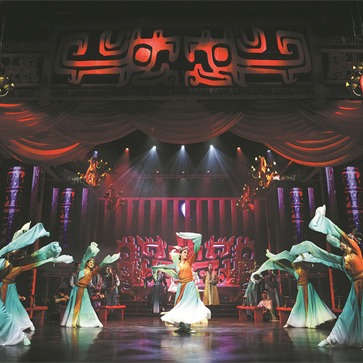
Don't miss the performances showcasing how the Shang people used oracle bones for fortune-telling, as well as the Shang stories recorded on the bones.

Cao Cao Gaoling Mausoleum Museum
In Anyang, history enthusiasts should visit the mausoleum museum of Cao Cao, a warlord and poet from the late Eastern Han Dynasty.
During the turbulent period at the end of the Eastern Han Dynasty, Cao unified northern China, paving the way for his son to establish the Wei Dynasty (220-265), one of the three dynasties that coexisted during the Three Kingdoms (220-280) period. This era marked a significant chapter in Chinese history and inspired numerous legends. Cao's writings, particularly his poetry, have also left a lasting legacy in literature.
Visitors can explore a replica of Cao's tomb chamber and view cultural relics unearthed from his mausoleum. They can also learn how his request for a frugal burial was honored and how archaeologists confirmed that this mausoleum belonged to Cao, despite initial debates following its discovery in 2008.

The National Museum of Chinese Writing
Taking the world's writing systems as the backdrop, the museum focuses primarily on Chinese characters, incorporating scripts from various ethnic groups as significant components. It brings together exemplary samples of Chinese writing throughout history, explaining the structural features and evolution of Chinese characters.
The museum also highlights the development of writing materials, such as oracle bones, bronze artifacts, silk and bamboo slips. It explores customs associated with Chinese characters, such as writing Spring Festival couplets and solving lantern riddles, providing a comprehensive view of the characters and illustrating why they are regarded as living fossils of Chinese civilization.
As the museum elaborates on jiaguwen, visitors can obtain a better understanding of Yinxu Ruins and the importance of jiaguwen in Chinese history.

Youlicheng site
The Youlicheng site in Anyang is a legendary prison believed to be where King Zhou of the Shang Dynasty held Ji Chang, who later became King Wen of the Zhou Dynasty, over 3,000 years ago.
According to legend, during the decline of the Shang Dynasty, amid political struggles and military defeats, Ji was captured by King Zhou and imprisoned.
During his seven years as a prisoner, Ji devoted himself to studying I Ching, or The Book of Changes, and developed its system. As a result, the site is considered a cradle of I Ching culture and a pivotal starting point for the Western Zhou Dynasty (c. 11th century-771 BC) rule.
The site features performances that showcase legendary tales from the transitional period between the Shang and Zhou dynasties.
It also includes a temple built during the Ming Dynasty (1368-1644) to commemorate Ji.
If you have any problems with this article, please contact us at app@chinadaily.com.cn and we'll immediately get back to you.

